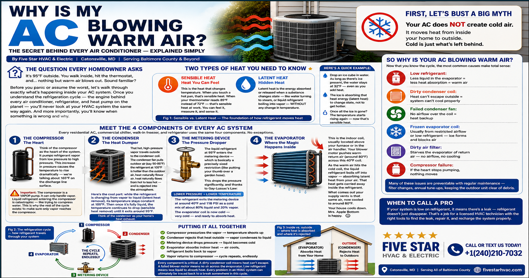
The Secret Behind Every Air Conditioner — Explained Simply
By Five Star HVAC & Electric | Catonsville, MD | Serving Baltimore County & Beyond
The Question Every Homeowner Asks
It’s 95°F outside. You walk inside, hit the thermostat, and… nothing but warm air blows out. Sound familiar?
Before you panic or assume the worst, let’s walk through exactly what’s happening inside your AC system. Once you understand the refrigeration cycle — the engine behind every air conditioner, refrigerator, and heat pump on the planet — you’ll never look at your HVAC system the same way again.
And more importantly, you’ll know when something is wrong and why.
First, Let’s Bust a Big Myth
Your AC does NOT create cold air.
Read that again. It does not create cold. There’s no cold generator inside your unit.
What it does is move heat. Specifically, it moves heat from inside your home to outside. Cold is just what’s left behind.
This is the entire foundation of the refrigeration cycle, and once it clicks, everything else will make sense.
Two Types of Heat You Need to Know
Before we walk through the cycle, you need two concepts under your belt:
Sensible Heat — Heat You Can Feel
This is the heat that changes temperature. When you touch a hot pan, that’s sensible heat. When your thermometer reads 85°F instead of 72°F — that’s sensible heat at work. You can feel it, measure it, and sense it.
Latent Heat — Hidden Heat
This one is sneaky. Latent heat is the energy absorbed or released when a substance changes state — like water turning to steam, or liquid refrigerant boiling into vapor — WITHOUT any change in temperature.
Here’s a quick example:
- Drop an ice cube in water. As long as there’s ice present, the water stays at 32°F — even as you add heat.
- The ice is absorbing that heat energy (latent heat) to change state, not to get hotter.
- Once all the ice is gone? The temperature starts rising again — now that’s sensible heat.
This matters enormously because the refrigeration cycle depends on latent heat to do most of its work.
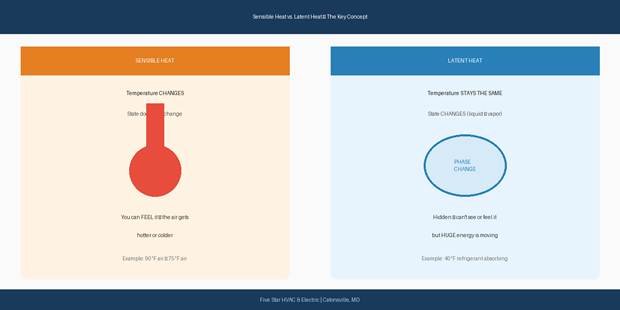
Fig 1: Sensible vs. Latent Heat — The foundation of how refrigerant moves heat
Meet the 4 Components of Every AC System
Every residential AC, commercial chiller, walk-in freezer, and refrigerator uses the same four components. No exceptions.

Fig 2: The refrigeration cycle — how refrigerant travels through your system
1. The Compressor — The Heart
Think of the compressor as the heart of the system. It pumps refrigerant vapor from low pressure to high pressure. This increase in pressure causes the temperature to rise dramatically — we’re talking about 165°F on the discharge line surface.
Important: The compressor is a VAPOR pump. It can only handle vapor. Liquid refrigerant entering the compressor is catastrophic — like trying to compress water. This is why the rest of the cycle exists: to make sure only vapor reaches the compressor.
2. The Condenser — The Heat Dumper
That hot, high-pressure vapor travels outside to the condenser coil. The condenser fan pulls outdoor air (say 90-95°F) across the coil. Since the refrigerant at 105°F is hotter than the outdoor air, heat naturally flows from hot to less hot — and is rejected into the atmosphere.
Here’s the cool part: while the refrigerant is changing from vapor to liquid (latent heat removal), its temperature stays constant at 105°F. Then once it’s fully liquid, the temperature continues to drop (sensible heat removal) until it exits around 95°F.
Think of the condenser as your home’s heat exhaust. That’s why your outdoor unit feels like a furnace when you stand near it — it’s dumping your indoor heat out.
3. The Metering Device — The Pressure Dropper
The liquid refrigerant at 95°F enters the metering device — which is basically a precisely sized restriction (like putting your thumb over a garden hose). This drops the pressure significantly, and thanks to Gay-Lussac’s Law:
Lower pressure = Lower temperature
The refrigerant exits the metering device at around 40°F and 118 PSI as a cold mix of about 80% liquid and 20% vapor. The evaporator coil is now cold — very cold — and ready to absorb heat.
4. The Evaporator — Where the Magic Happens Inside
This is the indoor coil, usually located above your furnace or in the air handler. Your blower motor pushes warm return air (around 80°F) across this 40°F coil.
As the warm air hits the cold coil, the liquid refrigerant boils off into vapor — absorbing latent heat from your air. That heat gets carried away inside the refrigerant. What comes out your supply vents is that same air, now cooled to around 60°F.
Your house cools down. Mrs. Apple Bottom is happy.
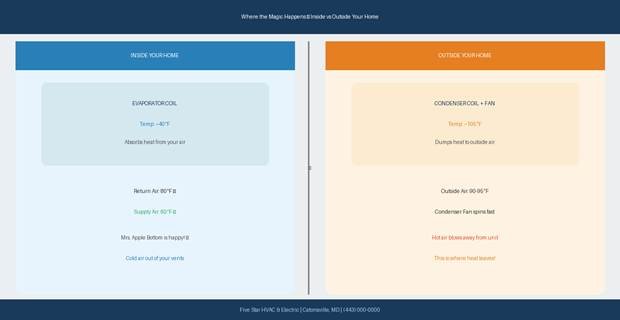
Fig 3: Inside vs. outside — where heat is absorbed and where it’s rejected
Putting It All Together
Here’s the full loop, in plain English:
- Compressor pressurizes the vapor → temperature shoots up
- Condenser rejects that heat outside → vapor condenses to liquid
- Metering device drops pressure → liquid becomes cold
- Evaporator absorbs indoor heat → air cools, refrigerant boils back to vapor
- Vapor returns to compressor → cycle repeats, endlessly
Every component is critical. A dirty condenser coil means heat can’t escape. A failed blower motor means no air across the evaporator. Low refrigerant means less liquid to absorb heat. Every problem in an HVAC system can ultimately be traced back to a break somewhere in this cycle.
So Why Is Your AC Blowing Warm Air?
Now that you know the cycle, the most common causes make total sense:
- Low refrigerant: Less liquid in the evaporator = less heat absorption = warm air
- Dirty condenser coil: Heat can’t escape outside = system can’t cool properly
- Failed condenser fan: No airflow over the coil = heat backup
- Frozen evaporator coil: Usually from restricted airflow or low refrigerant — ice forms and blocks air
- Dirty air filter: Starves the evaporator of return air — no airflow, no cooling
- Compressor failure: If the heart stops pumping, nothing moves
Many of these issues are preventable with regular maintenance — filter changes, annual tune-ups, keeping the outdoor unit clear of debris.
When to Call a Pro
If your system is low on refrigerant, it means there’s a leak — refrigerant doesn’t just disappear. That’s a job for a licensed HVAC technician with the right tools to find the leak, repair it, and recharge the system properly.
At Five Star HVAC & Electric, we serve Catonsville, Baltimore County, and surrounding areas. Whether it’s an AC that won’t cool, a heat pump acting up, or just a routine maintenance visit — we make it simple.
📞 Call or text us today
Five Star HVAC & Electric
Catonsville, MD | Serving All of Baltimore County
fivestarhvac.com